
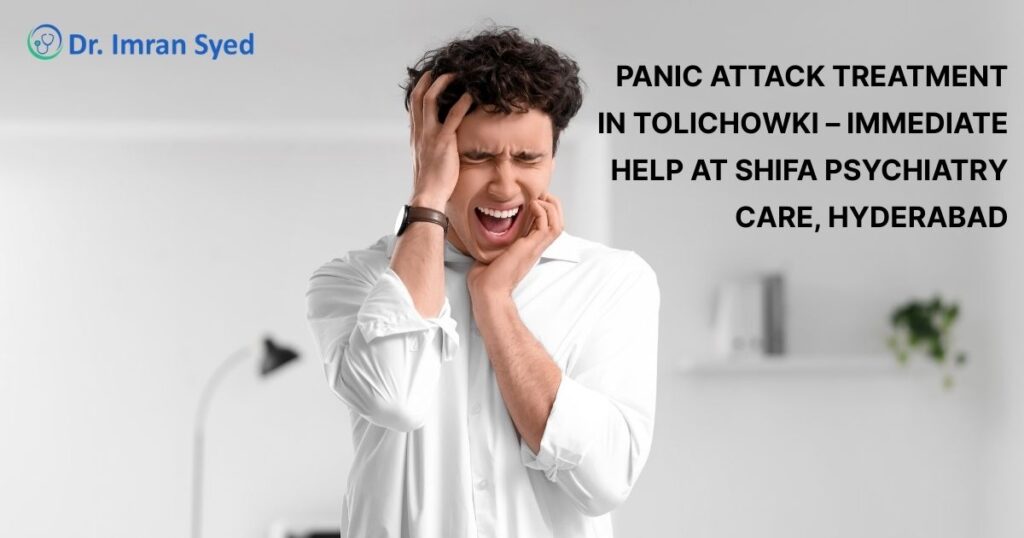
It can happen anywhere. In the middle of a crowded market near Tolichowki. While sitting in evening traffic on the Mehdipatnam road. At home, completely at rest, with no warning whatsoever. Your heart suddenly pounds so hard you can feel it in your throat. Your chest tightens. Your hands go cold. The room feels like it is closing in. And a wave of sheer, overwhelming terror tells you that something is terribly, catastrophically wrong.
If you have experienced this — you know exactly how frightening it is. And if it has happened more than once, you may already be living in quiet dread of when it will happen again.
What you experienced is a panic attack. And panic attack treatment in Tolichowki is available right where you live — at Shifa Psychiatry Care, where Dr. Imran Syed, MBBS, MD Psychiatry Gold Medalist with over 24 years of clinical experience, provides expert, confidential care for panic attacks and panic disorder for residents across Tolichowki, Mehdipatnam, Banjara Hills, Jubilee Hills, Attapur, and surrounding areas of Hyderabad.
You do not need to travel far for quality psychiatric care. Help is right here in Tolichowki.
Part I: What Exactly Is a Panic Attack?
A panic attack is a sudden, intense episode of fear or discomfort that reaches its peak within minutes and is accompanied by a cluster of physical and emotional symptoms. It is one of the most frightening experiences a person can go through — precisely because it happens so suddenly and feels so physically overwhelming.
The critical thing to understand about a panic attack is this: despite how terrifying it feels, it is not physically dangerous. Your heart is not about to stop. You are not dying. You are not losing your mind. What is happening is that your brain’s alarm system has misfired — triggering a full-body emergency response in a situation where there is no actual emergency.
Understanding this intellectually is one thing. Believing it in the moment — when your chest is tight and your heart is racing — is another. This is exactly why professional panic attack treatment in Tolichowki is so important. Because understanding alone is rarely enough to stop panic attacks from recurring. The right treatment addresses the neurological and psychological patterns driving them at their root.
Part II: Why Panic Attacks Are Particularly Common in Areas Like Tolichowki
Tolichowki is one of Hyderabad’s most densely populated and fast-moving neighbourhoods. The combination of heavy daily traffic, crowded streets, the pressure of urban professional life, and the demands of managing family responsibilities in a high-cost city creates a level of sustained background stress that many residents carry without fully recognising its impact.
Chronic stress is one of the most powerful triggers for panic attacks. When the nervous system is kept under sustained pressure for weeks and months — without adequate rest, recovery, and support — its threshold for triggering a fear response lowers significantly. Eventually, relatively minor situations can trigger a full panic response that feels completely disproportionate to what is happening in that moment.
This pattern is increasingly common among residents of Tolichowki, Mehdipatnam, and the surrounding areas of Hyderabad — and it is one of the primary reasons why panic attack treatment in Tolichowki is something more and more people are actively seeking.
Part III: Recognising the Signs of a Panic Attack
Many people who experience their first panic attack genuinely believe they are having a heart attack or a medical emergency. This is one of the most common presentations — patients arrive at emergency departments with chest pain and breathlessness, are thoroughly investigated, and are told everything is physically normal. It is only afterwards that the panic attack diagnosis is considered.
Recognising the signs of a panic attack is important — both for the person experiencing it and for family members who may witness it.
Physical Signs
- A sudden, intense racing or pounding heartbeat that feels alarming
- Chest tightness or chest pain that can genuinely feel like a cardiac event
- Shortness of breath or a feeling of being unable to get enough air
- Trembling or shaking in the hands, legs, or throughout the body
- Sweating — sometimes profuse — even in a cool environment
- Dizziness, lightheadedness, or a feeling that you might faint
- Numbness or tingling sensations — particularly in the hands, face, or feet
- A sensation of choking or a tight throat
- Nausea or stomach discomfort
Emotional and Cognitive Signs
- An overwhelming sense of impending doom — a feeling that something terrible is about to happen
- Intense fear of dying — particularly fear of a heart attack or stroke
- Fear of losing control completely or “going mad”
- An urgent, desperate need to escape from wherever you are
How Long Do Panic Attacks Last?
Most panic attacks reach their peak intensity within five to ten minutes and then begin to subside. By around twenty to thirty minutes, the most acute symptoms have usually passed — though the person is often left feeling exhausted, shaken, and deeply unsettled for hours afterwards.
Part IV: When a Panic Attack Becomes Panic Disorder
A single panic attack — while deeply unpleasant — does not necessarily indicate panic disorder. Many people experience one panic attack during an exceptionally stressful period and never have another.
Panic disorder develops when panic attacks recur and the person begins to live in persistent fear of the next episode.
Signs That Panic Attacks Have Become Panic Disorder
- You find yourself constantly worrying about when the next panic attack will come
- You no longer go certain places alone — you need a trusted person with you to feel safe
- You have changed your daily routine significantly to reduce the chance of having a panic attack
- The fear of panic attacks is affecting your work, your social life, or your relationships
If any of these points resonate with you, seeking panic attack treatment in Tolichowki as soon as possible is strongly advisable. Panic disorder responds extremely well to early treatment — and the longer it goes unaddressed, the more deeply the avoidance patterns can become embedded.
Part V: Panic Attack Treatment in Tolichowki at Shifa Psychiatry Care
At Shifa Psychiatry Care, Dr. Imran Syed provides a thorough, structured, and genuinely compassionate approach to panic attack treatment that addresses both the immediate symptoms and the underlying factors driving them.
Step 1: Thorough Psychiatric Assessment
Every patient at Shifa Psychiatry Care begins with a detailed, private consultation. Dr. Imran Syed takes the time to understand your specific experience — when the panic attacks first began, how frequently they occur, what situations tend to trigger them, how they are affecting your daily life, and whether there are other mental health factors such as generalised anxiety, depression, or stress that may be contributing.
This thorough assessment is what allows treatment to be precisely targeted rather than generic. Panic attacks can have several different underlying drivers — and identifying the correct one is essential for effective treatment.
Step 2: Education About Panic
One of the most powerful early steps in panic attack treatment is education. Understanding what is actually happening in the body during a panic attack — that it is a misfired alarm response, not a sign of physical danger — can significantly reduce the fear of the experience itself.
Dr. Imran Syed explains the neuroscience of panic in clear, accessible terms.
Step 3: Cognitive Behavioural Therapy
CBT is the most well-researched and consistently effective psychological treatment for panic attacks and panic disorder. It works on two levels simultaneously.
Replacing these interpretations with accurate, realistic ones removes the secondary fear that amplifies panic into a full episode.
At the behavioural level, CBT uses a carefully structured approach called interoceptive exposure — where patients are guided to face the physical sensations associated with panic in a controlled, supported way — so that the brain gradually learns that these sensations are not dangerous and do not need to be feared. Over time, this fundamentally rewires the panic response.
Step 4: Practical Techniques for Managing Acute Panic
Alongside therapy, Dr. Imran Syed teaches patients specific techniques they can use in real time when they feel panic beginning to rise. These include controlled diaphragmatic breathing to interrupt the hyperventilation cycle that intensifies panic symptoms, grounding techniques to stay connected to the present moment, and specific cognitive strategies to short-circuit catastrophic thinking before it escalates.
Step 5: Medication Where Appropriate
For patients with moderate to severe panic disorder — particularly where panic attacks are very frequent or where significant avoidance behaviour has developed — medication can be an important and highly effective part of treatment. Certain medications have been consistently shown to reduce both the frequency of panic attacks and the background anxiety that drives them.
Dr. Imran Syed makes all medication decisions carefully and conservatively, explaining the options clearly and monitoring the patient’s response at every follow-up. Medication is never prescribed as a standalone solution — it is always used alongside appropriate therapeutic work.
Step 6: Consistent Follow-Up Support
Recovery from panic disorder is a journey that unfolds over weeks and months.
Part VI: Why Choose Shifa Psychiatry Care for Panic Attack Treatment in Tolichowki?
Experienced Consultant Psychiatrist, Right Here in Tolichowki
Dr. Imran Syed brings over 24 years of psychiatric experience — including 14 years of international clinical practice in Saudi Arabia — to every patient consultation. His qualifications as an MBBS, MD Psychiatry Gold Medalist represent both academic excellence and deep clinical expertise.
Completely Confidential
Every consultation at Shifa Psychiatry Care is fully private. Nothing discussed within the clinic is shared with anyone outside under any circumstances. Patients can speak openly and honestly about everything they are experiencing without any concern about confidentiality.
Evening Hours Designed for Working Patients
The clinic operates from 8:00 PM to 10:00 PM, Monday to Saturday — specifically designed for patients who work during the day and cannot take time off for appointments. This means that receiving professional panic attack treatment in Tolichowki never has to interfere with your work or daily responsibilities.
Online Consultation Available
For patients who prefer the privacy of consulting from home, or who find it difficult to attend the clinic in person, online psychiatric consultation is available. Professional, expert care is accessible wherever you are.
Centrally Located and Easy to Reach
The clinic is located at Meraj Colony, Gate 3, Tolichowki — easily accessible for residents of Mehdipatnam, Banjara Hills, Jubilee Hills, Gachibowli, Attapur, Falaknuma, and across Hyderabad.
Part VII: You Do Not Have to Keep Living Like This
Panic attacks are not a life sentence. They are a treatable condition — and with the right professional support, the vast majority of people who seek treatment experience significant, lasting improvement.
Effective panic attack treatment in Tolichowki is available right where you live.
The first step is simply making one phone call.
Book Your Consultation Today
📞 Call Today: +91 86392 09712
📧 Email: Dr.imranpsychiatrist2@gmail.com
📍 Visit Us: 9-4-62/3/2, Meraj Colony, Gate 3, Tolichowki, Hyderabad – 500008
⏰ Consultation Hours: 8:00 PM to 10:00 PM
💻 Online Consultation Available
📱 Follow for Sleep Tips: @dr.imransyed
Disclaimer: This article is for informational and awareness purposes only. It does not constitute medical advice and is not a substitute for a professional psychiatric consultation.