Table of Contents
What Is Obsessive Compulsive Disorder?
Obsessive compulsive disorder — commonly known as OCD — is a chronic mental health condition characterised by two core features: obsessions and compulsions.
Obsessions are unwanted, intrusive thoughts, images, or urges that enter the mind repeatedly and cause significant anxiety or distress. The person experiencing them typically knows these thoughts are irrational — but cannot stop them from occurring.
Compulsions are repetitive behaviours or mental acts performed in response to obsessions — in an attempt to reduce the anxiety they cause or prevent a feared outcome.
OCD is not about being tidy, organised, or particular. It is a genuine psychiatric condition that causes real suffering — and it is one of the most treatable conditions in psychiatry when diagnosed accurately and treated properly.
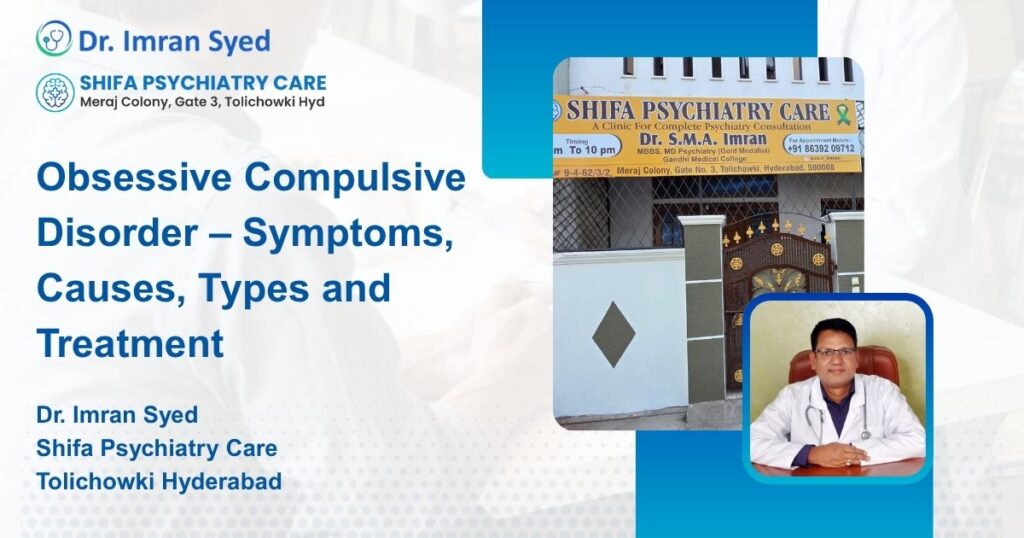
Dr. Imran Syed at Shifa Psychiatry Care, Tolichowki, Hyderabad has extensive clinical experience in diagnosing and treating obsessive compulsive disorder. He brings an MD Psychiatry Gold Medal and 24+ years of specialist psychiatric experience to every OCD consultation.
Contact: +91 86392 09712 | www.drimransyed.com
How Common Is OCD in India?
Obsessive compulsive disorder affects approximately 2 to 3 percent of the global population — making it one of the most prevalent psychiatric conditions worldwide. In India, millions of people live with OCD — many of them undiagnosed and untreated.
The average gap between the onset of OCD symptoms and receiving a correct diagnosis is 7 to 10 years. This delay happens because OCD is frequently misunderstood, misdiagnosed, or mistaken for anxiety, personality traits, or religious behaviour.
This delay has a real cost. OCD that goes untreated for years becomes more entrenched. The compulsions become more elaborate. The avoidance becomes more extensive. Daily life becomes progressively more restricted.
Early, accurate diagnosis and appropriate treatment at a clinic like Shifa Psychiatry Care significantly shortens this journey and improves long-term outcomes.
Obsessions — What They Are and How They Feel
Obsessions are the core driving force of obsessive compulsive disorder. Understanding them properly is essential to understanding the condition.
Key Characteristics of Obsessions
Repetitive — Obsessional thoughts come again and again. They are not occasional worries. They intrude repeatedly throughout the day — often hundreds of times — making normal functioning extremely difficult.
Intrusive — Obsessional thoughts arrive uninvited. The person does not choose to think them. They break into consciousness regardless of what the person is doing — during work, during prayer, during family time, in the middle of the night.
Ego-dystonic — This is one of the most important characteristics of OCD. The thoughts are ego-dystonic — meaning they feel completely alien to the person’s own values, beliefs, and personality. A deeply religious person experiencing intrusive blasphemous thoughts finds them horrifying precisely because they contradict everything they hold dear. This distress is, paradoxically, one of the diagnostic markers of OCD.
Irrational — The person with OCD typically knows, on an intellectual level, that the obsessional thought is irrational. They know that touching a door handle will not contaminate their family. They know that leaving the house without checking the lock seventeen times will not cause a catastrophe. But knowing something is irrational does not stop the anxiety it produces from feeling completely real.
Common Obsessional Themes
Obsessions in OCD cluster around a number of common themes — though the specific content varies significantly between individuals.
Contamination obsessions — Fear of germs, dirt, chemicals, or bodily fluids causing harm to oneself or others. These often drive excessive washing and cleaning compulsions.
Harm obsessions — Intrusive thoughts about accidentally or deliberately causing harm to oneself or loved ones. These thoughts are deeply distressing and entirely ego-dystonic — the person fears acting on them, even though they have no desire to do so.
Symmetry and order obsessions — An intense need for things to be arranged, aligned, or ordered in a precise way. Asymmetry or disorder produces severe anxiety.
Religious or moral obsessions (Scrupulosity) — Intrusive thoughts that violate the person’s religious beliefs or moral values. Fear of having sinned, blasphemed, or acted immorally — despite no evidence of having done so.
Sexual obsessions — Intrusive thoughts of a sexual nature that are unwanted and deeply distressing — often involving fears about one’s own sexuality or unwanted sexual imagery.
Checking obsessions — Fear that something has been left undone — doors unlocked, gas left on, errors made — that will cause catastrophic consequences.
Compulsions — Why People Perform Them
Compulsions develop as a response to obsessions. They are the person’s attempt to reduce the unbearable anxiety that obsessions produce.
What Compulsions Are
Compulsions are repetitive behaviours or mental acts performed to reduce obsessional anxiety or prevent a feared outcome. They provide temporary relief — but they never eliminate the obsession. In fact, they strengthen it.
Types of Compulsions
Motor compulsions — physical actions:
- Washing hands repeatedly until the skin breaks
- Checking locks, switches, or appliances multiple times
- Arranging objects until they feel “right”
- Touching objects in a specific sequence
- Repeating actions a set number of times
Mental compulsions — internal acts:
- Silent counting or repeating specific numbers
- Mental reviewing of past actions to check for errors
- Repeating prayers or phrases silently
- Seeking reassurance through internal questioning
- Mental neutralising — replacing a bad thought with a “good” one
Why Compulsions Make OCD Worse
This is the central paradox of obsessive compulsive disorder — and the key to understanding why it is so persistent.
Compulsions reduce anxiety briefly. That brief relief reinforces the compulsion — the brain learns that performing the compulsion was what made things safe. So when the obsession returns — and it always returns — the urge to perform the compulsion is even stronger.
Over time, compulsions become more elaborate, more time-consuming, and more demanding. What started as washing hands twice becomes washing them until they bleed. What started as checking the lock once becomes checking it forty times before leaving the house.
This escalating cycle is what makes OCD so debilitating — and why professional treatment, rather than simply “trying harder to resist,” is so essential.
The OCD Cycle — How It Maintains Itself
Understanding the OCD cycle explains why the condition persists without treatment — and why effective treatment targets the cycle directly.
Obsessional thought appears
        ↓
Intense anxiety and distress
        ↓
Compulsion performed to reduce anxiety
        ↓
Temporary relief
        ↓
Obsession returns — stronger
        ↓
Compulsion must be performed again
        ↓
Cycle continues and intensifies
Every compulsion performed confirms to the brain that the obsession was a genuine threat. Every avoidance of a feared situation teaches the brain that the situation is dangerous. Without treatment, this cycle deepens progressively.
Breaking this cycle is exactly what treatment for obsessive compulsive disorder at Shifa Psychiatry Care is designed to achieve.
Types of Obsessive Compulsive Disorder
OCD presents differently in different people. Understanding the main types helps explain why OCD is so frequently misdiagnosed — it does not always look the way people expect.
Contamination OCD
The most commonly recognised type. Characterised by fear of contamination — germs, dirt, illness, chemicals — driving compulsive washing, cleaning, and avoidance of perceived contaminants.
Checking OCD
Characterised by fear that something has been left undone — doors unlocked, appliances on, errors made — causing catastrophic consequences. Compulsive checking provides temporary reassurance but rapidly escalates.
Symmetry and Ordering OCD
Characterised by an intense need for things to be arranged, aligned, or symmetrical. Asymmetry produces severe distress. Compulsions involve repeated arranging, organising, or touching until things feel “just right.”
Harm OCD
Characterised by intrusive thoughts about accidentally or deliberately harming oneself or others. These are deeply distressing and entirely unwanted — the person fears the thought, not the action. Compulsions typically involve avoidance and reassurance-seeking.
Pure O — Primarily Obsessional OCD
Characterised by predominantly internal obsessions with less visible external compulsions. The compulsions are mental — internal reviewing, reassurance-seeking, mental neutralising. Pure O is one of the most underdiagnosed forms of OCD because the compulsions are not visible to others.
Scrupulosity OCD
Characterised by religious or moral obsessions — fear of having sinned, blasphemed, or violated moral codes. Compulsions often involve excessive prayer, confession, or seeking reassurance from religious figures.
Relationship OCD
Characterised by obsessional doubt about one’s relationship — is this the right person? Do I truly love them? Are they truly committed to me? These doubts are not based on evidence and are deeply distressing.
Symptoms of Obsessive Compulsive Disorder
Recognising the symptoms of OCD — in oneself or in someone you care about — is the first step toward getting the right help.
Cognitive Symptoms
- Unwanted, intrusive thoughts that feel impossible to control
- Intense distress when obsessional thoughts occur
- Knowing the thoughts are irrational but being unable to dismiss them
- Difficulty concentrating on anything other than the obsession
- Persistent doubt — “Did I do that correctly? Was that safe? Did I cause harm?”
Behavioural Symptoms
- Repetitive physical actions — washing, checking, arranging, counting
- Spending significant time — often hours — on compulsions daily
- Intense discomfort when unable to complete compulsions
- Avoiding situations, places, or objects that trigger obsessions
- Seeking constant reassurance from family or friends
Emotional Symptoms
- Persistent anxiety driven by obsessional thoughts
- Shame and embarrassment about the thoughts or behaviours
- Frustration and exhaustion from fighting the OCD cycle
- Depression developing alongside OCD over time
- Fear of being “crazy” or fundamentally different from others
Impact on Daily Life
- Significant time lost to compulsions — affecting work, study, and relationships
- Avoidance of social situations, workplaces, or relationships that trigger OCD
- Family members drawn into accommodation behaviours that maintain OCD
- Deteriorating quality of life as the condition progresses without treatment
Causes of Obsessive Compulsive Disorder
OCD does not have a single cause. Research points to a combination of neurological, genetic, and environmental factors.
Neurological Factors
Brain imaging studies consistently show differences in the functioning of specific circuits — particularly the connections between the orbitofrontal cortex, caudate nucleus, and thalamus — in people with OCD. These circuits are involved in error detection and the generation of “something is wrong” signals. In OCD, these circuits fire repeatedly and excessively — generating the persistent sense that something needs to be checked, corrected, or resolved.
Genetic Factors
OCD has a significant genetic component. People with a first-degree relative with OCD have a significantly higher risk of developing the condition themselves. This does not mean OCD is inevitable if there is a family history — but it does mean that genetic vulnerability plays a real role.
Serotonin System Dysfunction
The serotonin system plays an important role in OCD. This is supported by the clinical evidence — medications that work on the serotonin system are consistently the most effective pharmacological treatment for OCD.
Environmental and Psychological Factors
Stressful life events, childhood trauma, and significant life transitions can trigger the onset of OCD in people with underlying vulnerability. Certain learning patterns — particularly the experience that performing a specific action relieves anxiety — can establish and reinforce the OCD cycle.
Streptococcal Infection (PANDAS)
In some children, OCD symptoms develop or significantly worsen following a streptococcal infection. This specific subtype — known as PANDAS — requires specialist assessment and management.
How OCD Is Diagnosed
Accurate diagnosis of obsessive compulsive disorder requires clinical assessment by an experienced psychiatrist. There is no blood test or brain scan that diagnoses OCD. Diagnosis is based on a thorough clinical interview.
Dr. Imran Syed’s Diagnostic Process
Detailed clinical interview — Dr. Imran Syed takes the time to understand the full picture. The nature of the obsessional thoughts. The specific compulsions performed. How long the condition has been present. How much time OCD occupies each day. How it affects daily functioning, relationships, and work.
Distinguishing OCD from similar conditions — OCD can be mistaken for generalised anxiety disorder, psychosis, depression, or personality disorder. Dr. Imran Syed carefully distinguishes OCD from these conditions — because treatment differs significantly. This diagnostic precision is what makes treatment effective from the outset.
Severity assessment — understanding the severity of OCD determines the intensity and approach of treatment needed.
Assessment of co-occurring conditions — depression, anxiety, and other conditions frequently occur alongside OCD. Dr. Imran Syed identifies and addresses all co-occurring conditions as part of a comprehensive treatment plan.
Treatment for Obsessive Compulsive Disorder
Obsessive compulsive disorder responds very well to the right treatment. The two most effective evidence-based approaches are Exposure and Response Prevention therapy and medication — particularly when combined.
Exposure and Response Prevention (ERP)
ERP is the gold-standard psychological treatment for OCD. It is the most effective treatment available for this condition and is supported by decades of clinical research.
ERP works by systematically exposing patients to the thoughts, situations, or objects that trigger their obsessions — while supporting them in resisting the urge to perform compulsions. This process is carefully structured, gradually progressive, and conducted under the skilled guidance of Dr. Imran Syed.
Why ERP works: When a patient faces an obsession trigger without performing a compulsion — and discovers that the feared consequence does not occur — the brain begins to learn that the trigger is not genuinely dangerous. Over repeated exposures, the anxiety response to the trigger weakens. The OCD cycle loses its power.
What ERP involves in practice: The patient and Dr. Imran Syed work together to create an exposure hierarchy — a structured list of situations arranged from least to most anxiety-provoking. The patient gradually works through this hierarchy — facing each situation, tolerating the anxiety without compulsing, and allowing the anxiety to subside naturally.
This process requires courage. It is uncomfortable in the short term. But it consistently produces lasting results that no amount of compulsing alone can achieve.
Medication for OCD
Specific medications have been consistently proven effective for obsessive compulsive disorder — particularly those that work on the serotonin system.
SSRIs — used at specifically effective doses for OCD — reduce the intensity of obsessional thoughts, lower the anxiety driving the OCD cycle, and make engagement with ERP significantly easier.
Medication for OCD typically requires higher doses than those used for depression or anxiety — and takes longer to reach full therapeutic effect. Dr. Imran Syed selects and manages all OCD medication carefully — explaining every aspect of the approach and monitoring response consistently.
Combined ERP and Medication
For moderate to severe OCD, combined ERP and medication produces the best outcomes. Medication reduces the intensity of obsessions — making exposure exercises more manageable. ERP produces lasting neurological change — reducing reliance on medication over time.
What Does NOT Work for OCD
Reassurance-seeking — asking family members “Did I lock the door?” or “Do you think I contaminated that?” provides temporary relief but powerfully maintains OCD by functioning as a compulsion.
Avoidance — avoiding OCD triggers prevents the exposure that produces recovery. It consistently makes OCD stronger over time.
Simply trying to resist thoughts — fighting obsessional thoughts without professional guidance typically increases their frequency and intensity.
OCD Treatment at Shifa Psychiatry Care, Tolichowki Hyderabad
Shifa Psychiatry Care in Tolichowki, Hyderabad provides expert, evidence-based treatment for obsessive compulsive disorder — delivered by Dr. Imran Syed, one of Hyderabad’s most experienced consultant psychiatrists.
Why Choose Shifa Psychiatry Care for OCD Treatment
MD Psychiatry Gold Medalist — the highest academic distinction in postgraduate psychiatric training. Rare. Directly beneficial to every OCD patient treated.
24+ Years of Clinical Experience — extensive experience treating OCD across every type, severity, and complexity.
Diagnostic Precision — OCD is frequently misdiagnosed. Dr. Imran Syed’s clinical depth ensures accurate diagnosis from the outset — protecting patients from years of ineffective treatment.
Evening Hours — Monday to Saturday, 8:00 PM to 10:00 PM. OCD treatment available after your working day without disrupting professional responsibilities.
Complete Confidentiality — everything discussed at Shifa Psychiatry Care stays completely private — unconditionally.
Online Consultation Available — expert OCD treatment accessible from home.
No Referral Required — book directly by calling +91 86392 09712.
Centrally Located — Tolichowki, directly accessible from Mehdipatnam, Banjara Hills, Jubilee Hills, Attapur, and across Hyderabad.
Frequently Asked Questions
What is obsessive compulsive disorder?
Obsessive compulsive disorder is a chronic psychiatric condition characterised by unwanted, intrusive obsessional thoughts and repetitive compulsive behaviours performed to reduce the anxiety those thoughts produce. It is a treatable condition that responds well to ERP therapy and medication.
Is OCD a serious condition?
Yes. OCD is a clinically significant psychiatric condition that can be profoundly debilitating — consuming hours of every day, causing intense distress, and significantly restricting daily life. It requires proper professional treatment — not willpower or reassurance.
Can OCD be cured permanently?
OCD is highly treatable. Most patients who complete a proper course of ERP therapy — with medication where appropriate — achieve significant, lasting reduction in symptoms. Many achieve complete remission. Relapse rates after proper ERP treatment are significantly lower than without treatment.
Is OCD the same as being a perfectionist?
No. Perfectionism is a personality trait. OCD is a psychiatric condition involving genuine neurological dysfunction. The distress, time consumption, and loss of control in OCD are qualitatively different from simply preferring things to be done well.
Why is OCD so often misdiagnosed?
OCD is misdiagnosed because it presents in many different ways — not all involving visible cleaning or checking. Pure O, scrupulosity, harm OCD, and relationship OCD are frequently missed or mistaken for anxiety or depression. Accurate diagnosis requires an experienced specialist psychiatrist.
Can children have OCD?
Yes. OCD can develop at any age — including childhood. The average age of onset is 19 to 20 years, but many patients report symptoms beginning in childhood. Early diagnosis and treatment in younger patients is particularly important.
What is the best treatment for OCD?
ERP — Exposure and Response Prevention — is the gold-standard psychological treatment for OCD. Combined with appropriate medication, it produces the best long-term outcomes. Dr. Imran Syed at Shifa Psychiatry Care, Tolichowki provides both.
Is OCD treatment available online in Hyderabad?
Yes. Dr. Imran Syed offers online psychiatric consultation for OCD at Shifa Psychiatry Care — at the same clinical standard as in-person treatment.
How long does OCD treatment take?
This depends on the severity and duration of OCD. Many patients begin to notice meaningful improvement within 8 to 12 weeks of starting ERP. Significant recovery typically takes 4 to 6 months of consistent treatment. Longer-standing or more complex OCD may require longer-term management.
How do I book an OCD consultation at Shifa Psychiatry Care?
Call or WhatsApp +91 86392 09712. No referral needed. Evening appointments available Monday to Saturday. Online consultation also available.
OCD Is Treatable — Expert Help Is Right Here in Hyderabad
Obsessive compulsive disorder causes real suffering. But it does not have to be permanent. With the right treatment — accurate diagnosis, proper ERP therapy, and medication where needed — most people with OCD achieve significant, lasting recovery.
If you or someone you love is experiencing unwanted intrusive thoughts, repetitive compulsive behaviours, or the exhausting anxiety that characterises OCD — expert help is available right here in Tolichowki, Hyderabad.
Dr. Imran Syed at Shifa Psychiatry Care brings 24+ years of specialist psychiatric experience, an MD Psychiatry Gold Medal, and a genuine commitment to thorough, personalised care.
The first step is one phone call.
Book Your OCD Consultation at Shifa Psychiatry Care
📞 Call / WhatsApp: +91 86392 09712 📧 Email: Dr.imranpsychiatrist2@gmail.com 📍 Address: 9-4-62/3/2, Meraj Colony, Gate 3, Tolichowki, Hyderabad – 500008 ⏰ Hours: Monday to Saturday | 8:00 PM – 10:00 PM 💻 Online Consultation: Available for all conditions 🌐 www.drimransyed.com