Addiction has a quiet way of entering a person’s life. It rarely announces itself. It begins with a drink to relax after a long day at work, a cigarette to manage stress during a difficult project, or a phone that you pick up just to check one notification. Over time — slowly, almost invisibly — what began as a habit becomes a need. And what began as a need starts controlling your decisions, your relationships, your health, and your life.
If you or someone you love is struggling with addiction — whether to alcohol, tobacco, or even a smartphone — please know this: addiction is not a moral failing, it is not a weakness of character, and it is not something you simply need to “try harder” to overcome. It is a recognised medical condition with clear neurological causes, and it responds very well to proper professional treatment.
At Shifa Psychiatry Care in Tolichowki, Hyderabad, Dr. Imran Syed — MBBS, MD Psychiatry Gold Medalist psychiatric experience — provides compassionate, confidential, and evidence-based addiction treatment for residents across Hyderabad including Mehdipatnam, Gachibowli, Banjara Hills, Jubilee Hills, Attapur, and surrounding areas.
Part I: Understanding Addiction — What Is Really Happening in the Brain
Most people think of addiction as a matter of willpower. In reality, addiction is a brain disorder. When a person repeatedly engages in addictive behavior — whether drinking alcohol, smoking, or compulsively using a smartphone — the brain’s reward system undergoes real, measurable chemical changes.
The brain begins to associate the addictive substance or behavior with pleasure and relief. Over time, it reduces its natural production of feel-good chemicals like dopamine, because it has come to rely on the external source to produce them. This is why a person with addiction does not feel normal without their substance — not because they are weak, but because their brain chemistry has genuinely changed.
This is also why willpower alone is rarely enough to overcome addiction. The brain needs support — through proper psychiatric evaluation, structured treatment, and in many cases, medication and therapy — to rewire itself and return to healthy functioning.
Understanding this is the first step toward compassion — for yourself or for the person you are trying to help.
Part II: Alcohol Addiction — Signs, Impact, and Treatment in Hyderabad
Alcohol is deeply embedded in many social and professional environments across Hyderabad. For many people, it begins with occasional social drinking — at office gatherings in Gachibowli, celebrations in Banjara Hills, or casual evenings in Jubilee Hills. But for a significant number of people, casual drinking gradually crosses a line into dependence.
Signs of Alcohol Addiction
Recognising alcohol addiction early makes treatment significantly more effective. These are the signs that drinking has moved beyond social habit into a clinical problem:
Behavioral Signs:
- Drinking more than intended, and more frequently than planned
- Failed attempts to cut down or stop drinking on your own
- Spending a large amount of time obtaining alcohol, drinking, or recovering from its effects
- Giving up social, work, or family activities in favor of drinking
- Continuing to drink even when it is clearly causing problems in relationships or at work
Physical Signs:
- Needing to drink more alcohol to feel the same effect as before — this is called tolerance
- Experiencing withdrawal symptoms when you stop drinking — including tremors, sweating, nausea, anxiety, or difficulty sleeping
- Drinking in the morning or drinking to manage withdrawal symptoms
- Noticeable physical health changes such as weight loss, skin changes, or frequent illness
Emotional and Psychological Signs:
- Strong cravings for alcohol that are difficult to resist
- Using alcohol to manage stress, anxiety, loneliness, or emotional pain
- Feeling irritable, anxious, or depressed when you cannot drink
- Hiding your drinking from family members or lying about how much you consume
How Alcohol Addiction Affects Families in Hyderabad
The impact of alcohol addiction extends far beyond the person drinking. In many Hyderabad families, one member’s alcohol problem quietly reshapes the entire household. Children grow up in an environment of unpredictability and emotional insecurity. Spouses carry the weight of managing everything alone while also protecting the family from the consequences of their partner’s addiction. Financial stress accumulates. Trust erodes. And in many cases, the family suffers silently for years because of the stigma attached to seeking help.
This suffering is not inevitable. With proper psychiatric treatment, alcohol addiction can be managed effectively — and families can begin to heal.
Alcohol Addiction Treatment at Shifa Psychiatry Care
Dr. Imran Syed provides a structured, medically supervised approach to alcohol addiction treatment that addresses both the physical dependence and the underlying psychological factors driving it.
Treatment typically includes a thorough initial assessment to understand the severity of dependence and any co-occurring mental health conditions, medical management to safely address withdrawal symptoms, medication to reduce cravings and prevent relapse, behavioral therapy to identify and address the emotional triggers behind drinking, and regular follow-up consultations to monitor progress and adjust treatment as needed.
All treatment at Shifa Psychiatry Care is outpatient — meaning patients do not need to be admitted to a residential facility. They can receive professional, effective addiction care while continuing to live at home and maintain their daily responsibilities.
Part III: Smoking and Tobacco Addiction — More Than Just a Habit
Many people who smoke know they want to quit. They have tried patches, gum, and sheer determination — sometimes many times over. And yet they continue to smoke, often feeling deeply frustrated and ashamed of their inability to stop. If this sounds familiar, it is important to understand why.
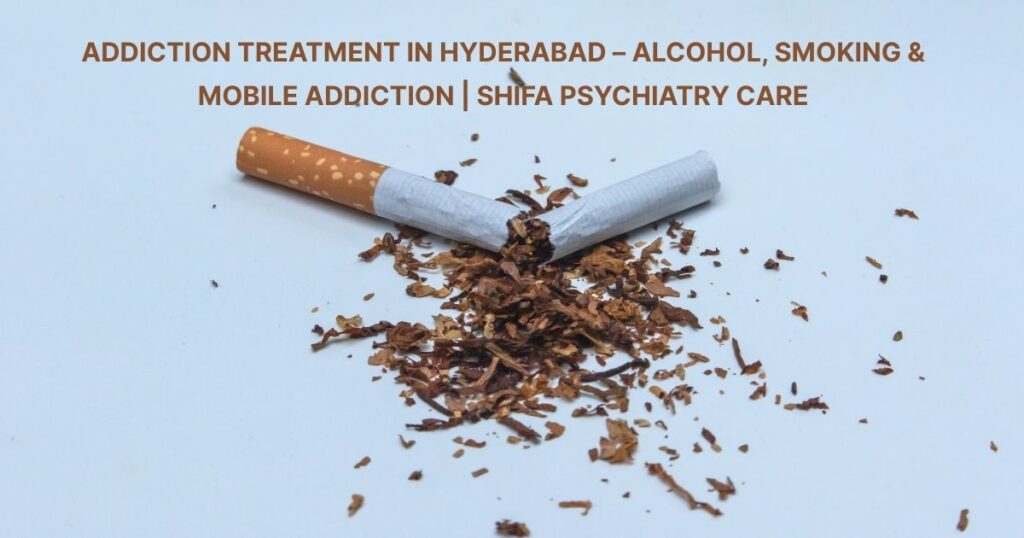
Nicotine is one of the most chemically addictive substances known to science. It reaches the brain within seconds of being inhaled and triggers an immediate release of dopamine — the brain’s pleasure chemical. Over time, the brain adjusts its chemistry around nicotine, making it genuinely difficult to feel calm, focused, or comfortable without it. This is not a matter of insufficient motivation. It is chemistry.
Signs That Smoking Has Become an Addiction
- You smoke first thing in the morning, within 30 minutes of waking up
- You feel anxious, irritable, or unable to concentrate when you have not smoked for a few hours
- You continue to smoke despite a doctor’s advice to stop due to health concerns
- You have tried to quit multiple times and have not been able to sustain it
- You smoke in situations where you know it is harmful or socially inappropriate
Health Consequences of Long-Term Smoking
The long-term health consequences of smoking are serious and well established — ranging from cardiovascular disease and chronic respiratory conditions to significantly increased cancer risk. But beyond the physical health impact, chronic smoking also affects mental health, often worsening anxiety and depression over time despite many smokers feeling that it helps them manage stress in the short term.
Smoking Cessation Treatment at Shifa Psychiatry Care
Dr. Imran Syed takes smoking addiction seriously as a medical condition — because that is exactly what it is. Treatment combines a detailed assessment of your smoking patterns and history, prescription medication where appropriate to reduce nicotine cravings and withdrawal symptoms, behavioral strategies to manage triggers and build new coping mechanisms, and ongoing support through the withdrawal period and beyond.
Many patients are surprised to discover that with proper psychiatric support, quitting smoking feels significantly more manageable than all their previous attempts without professional help.
Part IV: Mobile and Internet Addiction — The New Mental Health Challenge in Hyderabad
If you had suggested ten years ago that smartphone use could become a clinical addiction, many people would have been skeptical. Today, psychiatrists across India — and around the world — are seeing a significant and growing number of patients, particularly young people, who are genuinely struggling with compulsive smartphone and internet use.
This is especially relevant in a city like Hyderabad, where technology is central to both professional and social life. The same devices that make us more productive and connected can — for some people — become a source of compulsive, uncontrolled use that affects sleep, relationships, academic performance, and mental health.
What Is Mobile Addiction?
Mobile addiction — also referred to as smartphone addiction or internet use disorder — describes a pattern of smartphone or internet use that has become compulsive, distressing, and difficult to control despite negative consequences.
It is important to distinguish between heavy phone use — which is common and not necessarily a problem — and genuine addiction, where the phone use is causing significant harm and the person feels unable to stop or reduce it meaningfully.
Signs of Mobile Addiction in Adults and Young People
Behavioral Signs:
- Spending 6 or more hours daily on non-essential phone use, often without realising how much time has passed
- Feeling strong anxiety, restlessness, or irritability when the phone is unavailable or taken away
- Checking the phone compulsively — during meals, conversations, and even in the middle of the night
- Using the phone as the primary or only way to manage boredom, loneliness, or emotional discomfort
- Repeatedly promising to reduce screen time and being unable to follow through
Impact on Daily Life:
- Sleep disruption — staying up late due to phone use, waking up tired, and feeling unable to start the day without checking notifications
- Declining academic performance in students due to phone-related distraction
- Reduced productivity at work
- Withdrawal from face-to-face relationships and real-world activities
- Physical symptoms including eye strain, neck and back pain, and headaches from prolonged screen time
Mobile Addiction in Hyderabad’s Youth
Hyderabad’s students and young professionals are among the most digitally connected populations in India. While this brings real advantages, it also creates a specific vulnerability to mobile and social media addiction. Many young people in Tolichowki, Mehdipatnam, and across Hyderabad are spending their evenings and nights on their phones rather than sleeping, studying, or engaging in activities that genuinely nourish their mental health — and many of their parents are deeply worried but unsure how to help.
Mobile addiction in young people is not a parenting failure. It is a behavioral pattern that has neurological roots — and it responds well to proper psychiatric support.
Mobile Addiction Treatment at Shifa Psychiatry Care
Treatment for mobile and internet addiction at Shifa Psychiatry Care focuses first on understanding what need the phone is fulfilling — because compulsive phone use is almost always a symptom of something else, whether that is anxiety, depression, loneliness, boredom, or poor emotional regulation skills.
Dr. Imran Syed works with patients to identify those underlying drivers, develop healthier alternatives for managing their emotional needs, establish practical structures around phone use, and rebuild the capacity to engage meaningfully with real-world relationships and activities. Family involvement is encouraged where appropriate, particularly for younger patients.
Part V: Why Seeking Professional Help for Addiction Is the Right Decision
One of the biggest barriers to addiction treatment in Hyderabad — as in much of India — is stigma. Many people delay seeking help because they worry about what family members, colleagues, or neighbors might think if they knew. Others delay because they genuinely believe they should be able to handle it themselves.
Here is what decades of psychiatric research makes very clear: addiction that is left untreated almost always worsens over time. The earlier a person receives proper professional support, the better the outcomes — and the less damage happens to health, relationships, and quality of life in the meantime.
Choosing to seek help is not an admission of failure. It is one of the most informed and courageous decisions a person can make — for themselves and for everyone who cares about them.
At Shifa Psychiatry Care, every patient is received with complete confidentiality and without judgment. There is no pressure, no stigma, and no one-size-fits-all approach. Every person who walks through the door — or connects through an online consultation — receives a careful, individualised assessment and a treatment plan built around their specific situation and needs.
Part VI: Why Shifa Psychiatry Care Is One of the Best Clinics in Hyderabad for Addiction Treatment
Experienced Consultant Psychiatrist
Dr. Imran Syed is an MBBS, MD Psychiatry Gold Medalist clinical experience — including 14 years of international psychiatric practice in Saudi Arabia and a decade of dedicated practice in Hyderabad. His depth of experience across a wide range of psychiatric and addiction-related conditions means that every patient benefits from both academic excellence and real-world clinical wisdom.
Complete Confidentiality
Every consultation at Shifa Psychiatry Care is private and confidential. Nothing discussed within the clinic is shared externally under any circumstances. Patients can speak completely openly without fear of disclosure to family, employers, or anyone else.
Outpatient Treatment — No Admission Required
Unlike rehabilitation centres that require residential stays, Shifa Psychiatry Care provides effective addiction treatment on an outpatient basis. Patients can continue living at home, maintaining their work and family responsibilities, while receiving consistent professional support.
Conveniently Located in Tolichowki, Hyderabad
The clinic is centrally located at Meraj Colony, Gate 3, Tolichowki — easily accessible for residents of Mehdipatnam, Banjara Hills, Jubilee Hills, Gachibowli, Attapur, Falaknuma, and surrounding areas of Hyderabad.
Evening Hours Designed Around Working Patients
Clinic hours from 8:00 PM to 10:00 PM, Monday to Saturday, are specifically designed to accommodate patients who work during the day and cannot attend daytime appointments.
Online Consultation Available
For patients who prefer privacy or are unable to visit in person, online psychiatric consultation is available — making professional addiction support accessible from wherever you are in Hyderabad or beyond.
Take the First Step Today
If addiction — to alcohol, smoking, mobile devices, or any other substance or behavior — is affecting your life or the life of someone you love, effective and confidential help is available right here in Hyderabad.
You do not have to reach rock bottom before seeking support. Reaching out early makes recovery faster, smoother, and more complete.
📞 Call: +91 86392 09712
📧 Email: Dr.imranpsychiatrist2@gmail.com
📍 Visit: 9-4-62/3/2, Meraj Colony, Gate 3, Tolichowki, Hyderabad – 500008
⏰ Hours: 8:00 PM to 10:00 PM
💻 Online Consultation Available
📱 Follow: @dr.imransyed
Disclaimer: This article is for informational and awareness purposes only. It does not constitute medical advice or replace a professional psychiatric consultation. If you or someone you know is struggling with addiction, please consult a qualified mental health professional for an accurate assessment and personalised treatment plan.