Do you find yourself repeatedly checking if the door is locked, even though you know it is? Do unwanted thoughts intrude into your mind, causing distress that you can’t seem to shake? Do you feel driven to perform certain rituals or mental acts to reduce anxiety, even when you know they don’t make sense?
If this sounds familiar, you may be experiencing symptoms of Obsessive-Compulsive Disorder (OCD) , a condition that affects millions of people worldwide. The good news is that effective OCD treatment is available right here in Hyderabad.
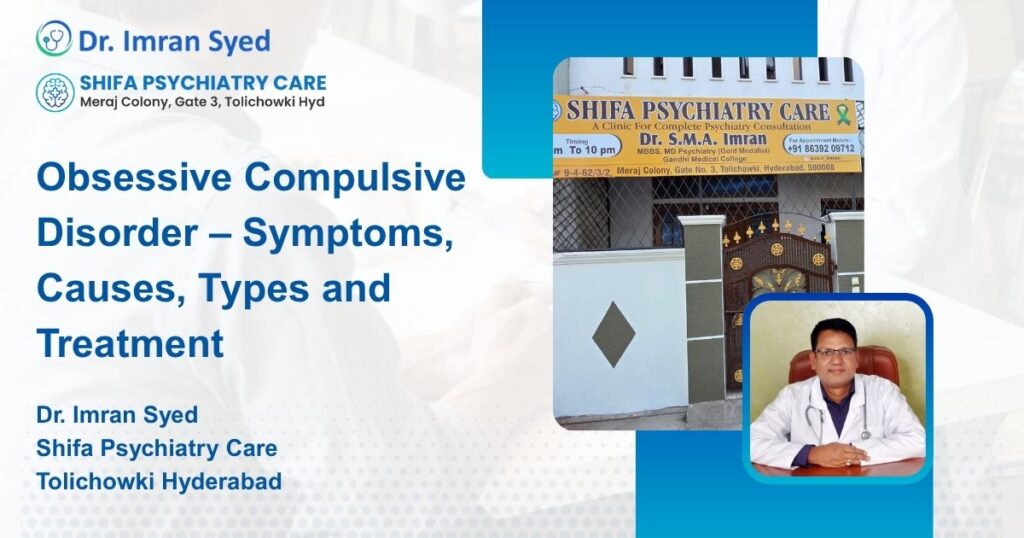
At Shifa Psychiatry Care, located at 9-4-62/3/2, Meraj Colony, Gate 3, Tolichowki, Hyderabad, Dr. Imran Syed provides specialized OCD treatment for residents across Gachibowli, Mehdipatnam, Banjara Hills, Jubilee Hills, and surrounding areas. With both in-person and online consultation available, expert help is within reach.
Part I: What Is OCD?
Obsessive-Compulsive Disorder (OCD) is a mental health condition characterized by a cycle of obsessions and compulsions that interfere with daily life.
The Two Components of OCD
| Component | Definition | Examples |
|---|---|---|
| Obsessions | Unwanted, intrusive thoughts, urges, or images that cause distress | Fear of contamination, unwanted violent thoughts, need for symmetry |
| Compulsions | Repetitive behaviors or mental acts performed to reduce anxiety caused by obsessions | Excessive washing, checking, counting, arranging, repeating words silently |
The OCD Cycle
- An obsession occurs – An intrusive thought enters your mind
- Anxiety rises – The thought causes significant distress
- Compulsion performed – You engage in a behavior to reduce anxiety
- Temporary relief – Anxiety decreases briefly
- Cycle repeats – The obsession returns, often stronger
This cycle can consume hours each day, interfere with work and relationships, and significantly reduce quality of life.
Part II: Common OCD Symptoms
Common Obsessions
Contamination Fears:
- Fear of germs, dirt, or illness
- Fear of touching objects others have touched
- Excessive concern about cleanliness
Harm-Related Obsessions:
- Fear of accidentally harming others
- Fear of being responsible for something terrible
- Intrusive violent or horrific images
Symmetry and Order:
- Need for things to be “just right”
- Distress when objects are asymmetrical
- Preoccupation with exactness
Unwanted Taboo Thoughts:
- Intrusive sexual or religious thoughts
- Thoughts that go against personal values
- Fear of acting on unwanted impulses
Doubting and Checking:
- Constant doubt about whether you did something
- Fear of making mistakes
- Need for reassurance
Common Compulsions
Cleaning and Washing:
- Excessive hand washing
- Repeated cleaning of objects or surfaces
- Elaborate decontamination rituals
Checking:
- Repeatedly checking locks, appliances, switches
- Checking body for signs of illness
- Checking that you didn’t make a mistake
Counting and Repeating:
- Counting in specific patterns
- Repeating actions a certain number of times
- Tapping or touching in sequence
Ordering and Arranging:
- Arranging items until they feel “right”
- Distress when things are moved
- Symmetry rituals
Mental Compulsions:
- Silently praying or repeating phrases
- Mentally reviewing events to prevent harm
- Replacing “bad” thoughts with “good” ones
Part III: What Causes OCD?
Biological Factors
- Brain chemistry: Imbalances in serotonin may contribute
- Brain structure: Differences in certain brain regions
- Genetics: OCD tends to run in families
Psychological Factors
- Learned behaviors: Compulsions develop because they temporarily reduce anxiety
- Thought patterns: Tendency to overestimate threat and responsibility
- Intolerance of uncertainty: Difficulty accepting that some things can’t be guaranteed
Environmental Triggers
- Stressful life events can trigger or worsen OCD
- Trauma may contribute to onset
- Major life transitions (marriage, new job, parenthood) can be triggering
Part IV: How OCD Affects Daily Life in Hyderabad
Living with OCD in a bustling city like Hyderabad presents unique challenges:
For Professionals in Gachibowli and HITEC City
- OCD symptoms interfering with work concentration
- Difficulty meeting deadlines due to rituals
- Anxiety about performance and making mistakes
- Avoiding certain tasks that trigger obsessions
For Residents in Crowded Areas Like Tolichowki and Mehdipatnam
- Contamination fears in crowded markets and public transport
- Difficulty with social situations due to intrusive thoughts
- Stress from noise and chaos triggering symptoms
- Avoiding certain areas to reduce anxiety
For Students
- Academic pressure worsening symptoms
- Difficulty studying due to intrusive thoughts
- Time consumed by rituals affecting grades
- Social isolation from peers
For Families
- Family members may not understand the condition
- Accommodating rituals can strain relationships
- Frustration and helplessness among loved ones
- Need for family education and support
Part V: OCD Treatment Options at Shifa Psychiatry Care
1. Cognitive Behavioral Therapy (CBT) with Exposure and Response Prevention (ERP)
ERP is the gold-standard treatment for OCD. It involves:
| Component | What It Means |
|---|---|
| Exposure | Gradually facing situations that trigger obsessions |
| Response Prevention | Choosing not to perform compulsions |
| Learning | Discovering that anxiety decreases naturally without compulsions |
| Building Confidence | Developing belief in your ability to cope |
How ERP Helps:
- Breaks the OCD cycle
- Reduces fear over time
- Teaches that anxiety passes naturally
- Restores freedom and flexibility
2. Medication Management
For moderate to severe OCD, medication can be very helpful:
- SSRIs (Selective Serotonin Reuptake Inhibitors) are first-line medications
- Higher doses often needed than for depression
- Takes 8-12 weeks to see full effect
- Works best combined with ERP therapy
3. Comprehensive Assessment
Dr. Imran Syed conducts thorough evaluations including:
- Detailed symptom assessment
- Understanding of how OCD affects your daily life
- Identification of specific triggers and patterns
- Evaluation of any co-occurring conditions
4. Personalized Treatment Planning
Treatment at Shifa Psychiatry Care is always tailored to you:
- Your specific OCD symptoms and severity
- Your preferences and goals
- Your lifestyle and daily responsibilities
- Your pace and comfort level
Part VI: Why Choose Shifa Psychiatry Care for OCD Treatment
Specialized Expertise
Dr. Imran Syed has extensive experience treating OCD using evidence-based approaches, helping patients break free from the cycle of obsessions and compulsions.
Comprehensive Services
- OCD assessment and diagnosis
- Cognitive Behavioral Therapy with ERP
- Medication management
- Family education and support
- Relapse prevention planning
- Online consultation available
Convenient Location
📍 9-4-62/3/2, Meraj Colony, Gate 3, Tolichowki, Hyderabad – 500008
Serving:
- Tolichowki
- Mehdipatnam
- Gachibowli
- Banjara Hills
- Jubilee Hills
- HITEC City
- And surrounding areas
Flexible Hours
⏰ Consultation Hours: 8:00 PM to 10:00 PM
Online Consultation Available
💻 Virtual appointments for those who prefer remote care
Part VII: Taking the First Step
If OCD has been controlling your life, effective help is available. You don’t have to struggle alone.
📞 Call: +91 86392 09712
📧 Email: Dr.imranpsychiatrist2@gmail.com
📍 Visit: 9-4-62/3/2, Meraj Colony, Gate 3, Tolichowki, Hyderabad – 500008
⏰ Hours: 8:00 PM to 10:00 PM
💻 Online Consultation Available
📱 Follow: @dr.imransyed
Disclaimer: This content is for informational purposes only and does not constitute medical advice. Always consult a qualified mental health professional for diagnosis and treatment tailored to your specific situation.